|

New insights highlight why modern contract management requires clarity, collaboration, and stronger leadership.
Recent global research from WorldCC, conducted in partnership with Deloitte, shows a striking development: nearly 40% of professionals believe contracts do not fulfil their fundamental purpose—a sharp rise from 27% in 2017.
For organisations, this signals a growing gap between what contracts are meant to achieve and how they are actually used.
At C-Learn, we see this challenge every day: teams work with increasingly complex contracts, but lack a shared understanding of the contract’s role in supporting performance, collaboration, and overall business outcomes.
According to WorldCC, contracts serve at least 11 distinct purposes. The top priorities among members remain:
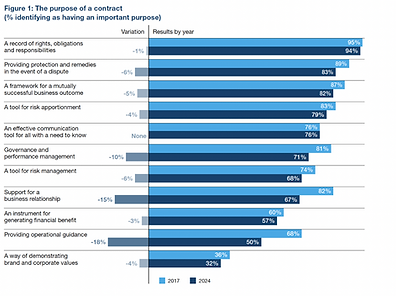
Source: WorldCC, September 2024
Additional purposes include enabling communication, supporting ongoing contract management, handling emerging risks, and generating financial value. Surprisingly, financial impact ranks only eighth—illustrating how multi-dimensional modern contracting has become.
Even more notable is the decline in how respondents view contracts as tools for:
➢ strengthening relationships
➢ guiding operational management
➢ demonstrating brand values or ESG principles
This shift raises a crucial question: are organisations pursuing the right purposes—and do stakeholders even agree on what these are?
The research highlights a key problem: leaders often lack a comprehensive understanding of the different purposes contracts should serve.
When contract ownership is anchored too narrowly—often in Legal, Procurement, or Finance—organisations risk over-optimising for one purpose (e.g., legal protection) at the expense of others (e.g., performance, collaboration, or value creation).
One WorldCC member from the aerospace sector describes how merging Legal with Contract/Commercial functions unintentionally shifted the organisation’s contracting mindset. The result:
➢ more defensive risk conditions
➢ less focus on delivery and performance
➢ weaker relationship quality
➢ reduced financial outcomes
In other words: the purpose of contracts drifted—because no one actively defined it.
When organisations emphasise one purpose—often legal protection—over others, the consequences ripple across the contract lifecycle:
➢ inconsistent expectations
➢ unclear priorities
➢ siloed behaviours
➢ conflict between stakeholders
➢ contracts becoming “political” instruments rather than practical tools
This misalignment is especially problematic today, where contracts must quickly adapt to GDPR requirements, sustainability frameworks, cybersecurity regulations, and rapidly changing commercial landscapes.
Leadership must therefore take responsibility for shaping a shared, organisation-wide understanding of what contracts are for—and how they should be managed.
WorldCC suggests an overarching principle that can guide alignment:
The purpose of a contract is to protect and promote the parties’ shared economic interests by establishing a clear, mutual agreement on rights, obligations, and expectations.
This definition integrates both the legal enforceability and the practical, relational dimension. Contracts become:
➢ legal anchors
➢ frameworks for accountability
➢ tools for collaboration
➢ enablers of commercial outcomes
This perspective is central to how C-Learn teaches contract management: clarity of purpose is the foundation for effective contract planning, negotiation, execution, and ongoing management.
WorldCC encourages organisations to challenge traditional contracting practices. Key recommendations include:
➢ Strengthen collaboration to ensure contracts create mutual value
➢ Make contracts operational, with clear deliverables and the outcomes they support
➢ Define deal-specific “must-haves” rather than relying on generic templates
➢ Manage risk pragmatically, not by attempting to predict every scenario
➢ Shift negotiation focus toward delivery, governance, and ecosystem collaboration
➢ Use data to determine whether contract frameworks remain fit-for-purpose
These principles align strongly with C-Learn’s course curriculum and our approach to modern contracting: practical, value-driven, and dynamic rather than rigid and reactive.
The report concludes clearly: leaders must drive the transformation of contracting practices.
To succeed, leadership teams, legal departments, and contract managers must be willing to:
➢ challenge traditional assumptions
➢ embrace more collaborative and cross-functional approaches
➢ make contract purpose an explicit conversation
➢ model new behaviours in negotiations and contract management
➢ build the skills and systems needed to support modern contract lifecycles
At C-Learn, we believe this shift begins with training—helping organisations build shared language, shared competencies, and shared frameworks for working with contracts.
A contract without a clear purpose will always underperform.
A contract with a shared, well-defined purpose becomes a strategic asset—one that reduces disputes, improves delivery, strengthens relationships, and drives long-term value.
By understanding contract purpose holistically, professionals can:
➢ negotiate more effectively
➢ manage suppliers with clarity and confidence
➢ reduce avoidable risks
➢ build stronger collaboration
➢ design contracts that actually support commercial success
This is exactly what C-Learn’s training is designed to deliver: practical, accessible, and internationally recognised contract management skills that help organisations unlock the full value of their contracts.





.png)